SEO for HVAC and heating manufacturers
SEO for HVAC manufacturers, with a worked example from a US heating manufacturer that grew organic leads from zero to 50+ a month.

SEO for HVAC manufacturers makes heating, ventilation and air conditioning products easy to find for the contractors, engineers and facility teams who specify them. It rests on clear product and application pages, a clean technical base, steady authority building and measurement tied to leads.
This article uses one campaign as a worked example throughout. Between October 2024 and September 2026, we worked with a US B2B heating and insulation manufacturer. Its organic visits grew from 5 to 2,762 a month, and its organic leads from none to more than 50 a month.
What makes search different for HVAC and heating manufacturers
HVAC and heating products sit between two worlds. They are technical products bought by professionals, but they are also searched for by property owners who want to understand their options.
A manufacturer has to decide which of these audiences each page is for. A page that tries to serve a homeowner and a mechanical engineer at once usually serves neither well.
| Audience | What they search for | Pages that serve them |
|---|---|---|
| Mechanical engineers and specifiers | Outputs, efficiency, dimensions, standards and design guidance | Product pages with full specifications, sizing guides and design documents |
| Contractors and installers | Installation methods, compatibility, lead times and where to buy | Installation guides, dealer or distributor pages and product comparisons |
| Facility and estates managers | Running costs, maintenance and replacement options | Application pages, case studies and maintenance guidance |
| Architects and designers | Appearance, space needs and how products fit a building | Application galleries, drawings and project examples |
| Property owners | Whether a product type suits their building | Plain explanations that point them to a contractor or distributor |
Three further features make HVAC search distinct. Demand is seasonal, product terms are highly technical, and many manufacturers run several brand or product sites. The worked example below shows how each of these played out.
For a wider benchmark, we built a search benchmark for S&P 500 manufacturers that compares the search performance of all 88 manufacturers in the S&P 500. Their combined search traffic fell 41% in a year.
The worked example: a US heating and insulation manufacturer
The company has been in the market since 2000. It sells to business buyers in the United States.
When we started in October 2024, its content was spread across three domains. The main domain had a domain rating of 3 and 12 referring domains, according to Ahrefs. Organic search brought in almost no visits and no qualifying leads.
The table below links each HVAC-specific problem to what we did and what changed.
| Problem | What we did | Result (Ahrefs unless stated) |
|---|---|---|
| Content split across three domains | Analysed 71 URLs, moved the strongest to one main domain with 301 redirects, removed outdated pages | Organic visits rose from 5 in October 2024 to 506 in December 2024 |
| Technical errors across product pages | Site audit covering broken links, slow pages, indexing, mobile usability and load times | 99% of URLs free of errors |
| Weak authority against established brands | Steady link building, rising from 5 to 10 to 15 links a month, plus links from the company’s other brand sites | Domain rating from 3 to 61; referring domains from 12 to 1,522 (127x) |
| No link between search and sales | Tracking in Google Analytics, Ahrefs and Google Search Console | 50+ qualifying leads a month from organic search (client reporting) |
The company now ranks on the first page of Google for several high-intent US keywords. These are the searches professional buyers make when they compare suppliers.
Brand domains: when to merge and when to keep
Many HVAC manufacturers grow through product lines or acquisitions. Each line often gets its own website, and over time the company ends up with several small domains.
In the worked example, we merged the core content onto one domain but did not close the others. The two secondary domains stay live and generate leads through pay per click advertising. Those sites still had a clear job to do.
We also used the company’s other brand websites to send relevant links to the main domain. This meant the group’s own assets supported the site that mattered most for organic search.
If you are weighing a merger, Google’s documentation on site moves is a useful reference. It says 301 and other permanent redirects do not cause a loss in PageRank, and it recommends keeping redirects for at least one year.
Technical product pages for HVAC
HVAC product pages carry a lot of technical detail. Outputs, efficiency figures, dimensions, electrical data and approvals all matter to the person specifying.
Put this detail in the page text, not only in data sheets. Google’s guidance on its AI features advises keeping important content in text form. The same detail also helps buyers compare products without downloading files.
List figures in the units your buyers work in, and use the product terms they search for rather than internal catalogue codes. Your sales and applications teams can tell you which terms customers use.
In the worked example, we also added structured data and rewrote meta titles and descriptions across the site. Google’s product structured data documentation describes product snippets for pages where visitors cannot buy directly. That describes most HVAC manufacturer catalogues, where sales go through distributors or a sales team.
Internal links matter as much as the pages themselves. We rebuilt the header and footer menus so that key product pages were easier to reach from anywhere on the site.
Free audit
Get an enterprise SEO audit of your site
Tell us your website and work email. Our team replies within one working day.
Building authority in a crowded category
Heating and ventilation are mature markets with long-established brands. A newer or smaller domain needs authority to compete with them in search results.
The chart below shows how domain rating moved over the two years of the campaign.
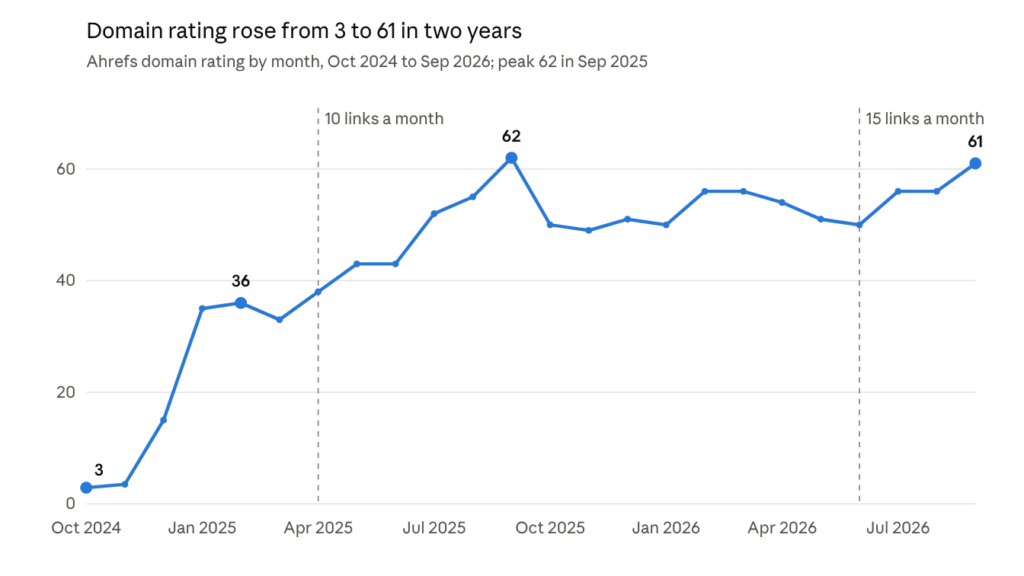
Domain rating reached 36 in under four months and 62 by September 2025. It then held in a range of 49 to 56 for most of the following year, before reaching 61 in September 2026.
Ahrefs describes domain rating as a relative metric on a 100-point scale. A site’s score can fall even when its own links stay the same, because other sites gain links. For this reason we judged progress against similar sites rather than against the previous month.
The link rate stayed steady throughout. It started at 5 links a month, rose to 10 a month in April 2025 and to 15 a month in June 2026. Our digital PR service covers the wider authority work we do for industrial clients.
Distributors, representatives and contractors
Many HVAC manufacturers sell through distributors, manufacturer’s representatives and approved installers. Each of these partners can help or hinder your search visibility.
Partners often copy product descriptions from the manufacturer’s site. When many sites carry the same text, search engines must choose which page to show, and it may not be yours. Ask partners to add their own local information, such as stock, service areas and installation experience, rather than copying text word for word.
Partners are also a good source of relevant links. A distributor’s product listing that links to the matching product page on your site helps buyers find full specifications. It also connects the partner’s page to yours.
On your own site, a clear “where to buy” or “find an installer” section helps contractors and property owners reach the right partner. It also gives search engines a page to show for searches that include a location.
Seasonality in heating search
Heating demand rises and falls with the seasons, and search behaviour often follows. A heating manufacturer should expect uneven monthly traffic and plan reporting around it.
In the worked example, organic visits rose from 1,479 in December 2025 to 2,616 in January 2026, and peaked at 2,967 in March 2026. They then fell to 2,248 in May 2026 before rising to 3,134 in August 2026.
We cannot say how much of the spring 2026 fall was seasonal, because other factors also change search results. What it does show is the value of comparing results by quarter or by year, not month by month.
AI search and HVAC buyers
Buyers now also ask ChatGPT, Perplexity and Google AI Overviews which products or suppliers suit a project. These tools draw on web content, so clear and specific pages help.
Google says there are no additional requirements to appear in AI Overviews or AI Mode, and that existing SEO fundamentals remain worthwhile. Its AI features may run several related searches across subtopics to build an answer. For an HVAC manufacturer, that favours a site with a clear page for each product type, application and common question.
Our AI SEO service explains how we track and improve visibility in AI tools.
Measuring SEO for HVAC manufacturers
The most important figure in the worked example was leads. Organic search went from no qualifying leads to more than 50 a month, according to the client’s reporting.
This matters because many manufacturing marketers struggle to show return. In Content Marketing Institute research (outlook for 2025), 64% of manufacturing marketers said they have difficulty attributing return on investment to content. The same research found that 37% expected their content budget to increase in 2025.
Rising budgets bring closer scrutiny. Agree with your sales team how a qualified lead is defined, and track it from the first month.
How to apply this to your own business
Start by checking how many domains your content sits on, and whether your product pages hold their key figures in text. Then build authority steadily, measure leads, and review progress by quarter.
You can read more about the worked example on our heating manufacturer case study page, and about our approach on our SEO services page. If you want a review of your own site, contact our team.
Frequently asked questions
Is SEO worth it for HVAC manufacturers?
It can be, when buyers research products online before they contact suppliers. In the worked example, organic search went from no qualifying leads to more than 50 a month.
Should HVAC content target homeowners or professionals?
Decide per page. Most manufacturers should focus on engineers, contractors and facility teams, with simple pages that point homeowners to an installer.
How do we handle several brand websites?
Review each URL’s clicks, depth and relevance, then decide whether to merge, keep or remove it. Secondary sites can stay live for paid search.
Does seasonality affect heating search?
Heating demand is seasonal, so expect uneven months. Compare results by quarter or year rather than month by month.
How long before HVAC SEO shows results?
In the worked example, domain rating reached 36 in under four months. The largest traffic gains came in the second year.
Do HVAC product pages need structured data?
It helps. Product structured data can show richer details in Google Search, and it supports clear, consistent product information.
Sources
- Google Search Central: Site moves with URL changes
- Google Search Central: AI features and your website
- Google Search Central: Introduction to Product structured data
- Ahrefs Help Center: What is Ahrefs Domain Rating and how is it calculated?
- Content Marketing Institute: Manufacturing content marketing benchmarks, budgets and trends, outlook for 2025