SEO case study: how a US heating manufacturer grew from 5 to 2,762 organic visits a month
An SEO case study from a US heating manufacturer: one domain, technical fixes and steady link building took organic traffic from 5 to 2,762 visits a month.

This SEO case study covers a US heating and insulation manufacturer that grew from 5 to 2,762 organic visits a month in two years. Three pieces of work drove it: merging three websites into one, fixing the technical base and building links every month.
The company is a B2B manufacturer that has been in the market since 2000. The campaign ran from October 2024 to September 2026. It sells to business buyers in the United States, where a purchase often follows weeks of research and comparison.
Before the campaign, almost none of that research brought buyers to its website.
That matters because buyers now do much of their research alone. In a Gartner survey of 632 B2B buyers, 61% said they prefer a buying experience without a sales representative. If a manufacturer is not visible in search, buyers form their shortlist without it.
All figures below come from Ahrefs unless stated otherwise. Lead numbers come from the client’s own reporting.
Results at a glance
Organic visits rose 552x, from 5 a month in October 2024 to 2,762 in September 2026.
| Measure | October 2024 | September 2026 | Change |
|---|---|---|---|
| Organic visits a month (Ahrefs) | 5 | 2,762 | 552x |
| Domain rating (Ahrefs) | 3 | 61 | +58 points |
| Referring domains (Ahrefs) | 12 | 1,522 | 127x |
| Qualifying leads a month from organic search (client reporting) | 0 | 50+ | From zero |
The highest month in the period was August 2026, with 3,134 organic visits. The company now ranks on the first page of Google for several high-intent US keywords. These are searches made by buyers who are comparing suppliers, not students or researchers.
To compare these results with the largest industrial companies, see our report covering all 88 manufacturers in the S&P 500.
The starting point: one company, three websites
The main problem was not the products or the market. The company’s content was spread across three separate domains, and each one was small. Search engines saw three weak websites instead of one established manufacturer.
In October 2024, the main domain had a domain rating of 3 and only 12 referring domains. For a business with more than 20 years of trading, that was far below its real standing. Buyers searching for its product types found other suppliers first.
Splitting content across domains has a clear cost. Links earned by one site do not help the other two. Pages on different domains also compete for the same searches, so none of them ranks well.
Business buyers of heating products search in specific ways. They use product types, applications and technical terms. A site needs one clear, strong page for each of these searches to appear in the results.
Step 1: deciding what to move
We analysed 71 URLs across the three domains before moving anything. Each URL was judged on three signals, shown in the table below.
| Signal | What we checked | What it decided |
|---|---|---|
| Clicks | Which pages already received visits from Google | Pages with real visits were kept and moved |
| Content depth | Whether the page answered a buyer’s technical questions | Thin pages were merged into stronger ones |
| Relevance | Whether the page matched current products and markets | Outdated pages were removed |
Every page that moved received a 301 redirect from its old address to its new one. Google’s documentation says that 301 and other permanent redirects do not cause a loss in PageRank. It also recommends keeping redirects in place for at least one year.
The relaunch put all core content on one main domain. We also rebuilt the header and footer menus so buyers and search engines could reach key product pages in fewer clicks.
The two secondary domains were not closed. They stay live and generate leads through pay per click advertising. This kept the company’s paid channels working while organic authority moved to one place.
Step 2: fixing the technical base
A full site audit came next. It covered broken links, slow pages and indexing problems, along with site structure, mobile usability and load times.
After the fixes, 99% of URLs were free of errors. We also added structured data, rewrote meta titles and descriptions, and improved internal links between related pages.
Google advises writing descriptive and concise title elements and avoiding repeated or boilerplate text. On a manufacturer’s site, many pages start from the same template, so this step needed care. Each product page received a title that described that product, not the range.
We also removed outbound links that were not relevant to the company’s products. A page linking to unrelated sites sends mixed signals about its subject.
Step 3: building authority at a steady rate
We built 276 links over the 24 months. The rate rose in stages as the site grew.
| Period | Links built a month | Domain rating at end of period (Ahrefs) |
|---|---|---|
| October 2024 to March 2025 | 5 | 33 |
| April 2025 to May 2026 | 10 | 51 |
| June 2026 to September 2026 | 15 | 61 |
Domain rating rose from 3 to 36 in under four months. It reached 62 in September 2025, then moved between 49 and 56 for most of the following year. It closed the period at 61.
Ahrefs describes domain rating as a relative score on a 100-point scale. A site’s score can fall even when its own links stay the same, because other sites gain links. This is why the line does not rise smoothly, and why we judged it against similar sites.
The company also owns two other brand websites. We used them to send relevant quick-win links to the main domain, so the group’s own assets supported its core site. These links are part of the 276 total.
Referring domains grew from 12 to 1,522 over the campaign, a 127x increase. That figure includes every site Ahrefs found linking to the domain, not only the links we placed.
Step 4: measuring what buyers did
We tracked the campaign in Google Analytics, Ahrefs and Google Search Console. Each tool answered a different question.
Ahrefs showed authority and estimated traffic. Google Search Console showed the actual searches and pages that earned clicks. Google Analytics showed what visitors did after they arrived.
In Google Search Console we looked at clicks for individual queries and pages, not site-wide averages. This showed which product pages were starting to earn visits from buyers. Those pages then received more internal links and, where needed, more technical detail.
The measure that mattered most was leads. Before the campaign, organic search produced no qualifying leads. By the end, it produced more than 50 a month, according to the client’s reporting.
Measuring this way is less common than it should be. In research from the Content Marketing Institute, 64% of manufacturing marketers said they have difficulty attributing return on investment to content. Tying search work to leads from the start avoids that problem.
2,762
organic visits a month, from 5
Free audit
Get an enterprise SEO audit of your site
Why the work was done in this order
The order of the steps was a deliberate choice. Each step made the next one more effective.
Links had to point at the final domain. Building links before the migration would have sent authority to addresses that were about to change. Every redirect adds a step between the link and the page it supports.
The technical fixes came before the main link building for a similar reason. A link to a slow page, or to a page Google cannot index, does little for the site. Fixing these first meant each new link supported pages that could rank.
Link building then ran every month for the full two years. Authority in search builds over time, and a short burst of links followed by nothing rarely holds its value. A steady rate also made progress easier to measure, because we could compare like with like each month.
This order is not unique to heating. Any manufacturer with content on several domains, an old template or a large product range faces the same choice. Fix the structure first, then add authority to it.
How traffic grew month by month
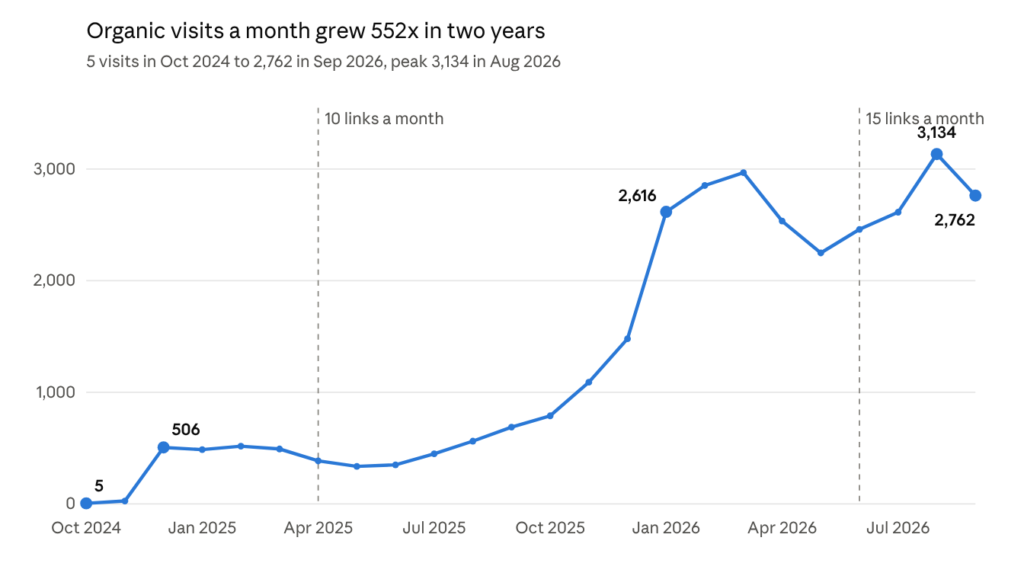
Growth was not a straight line. Traffic jumped to 506 visits in December 2024, soon after the migration. It then held steady through the first half of 2025, falling to 336 in May.
From July 2025 traffic rose every month, reaching 2,616 in January 2026.
There was a dip in April and May 2026, to 2,248, before a new high of 3,134 in August. Short dips like these are normal in a long campaign. We judged progress over quarters, not single months.
What other manufacturers can learn from this SEO case study
Five points from this campaign apply to most established manufacturers.
- Check for domain sprawl first. If your content sits on several domains, new content and links will be split between them. Merging them can do more than any single new page.
- Decide page by page, using data. We did not move everything. Clicks, depth and relevance decided which of the 71 URLs moved, merged or went.
- Keep link building steady. The rate went from 5 to 10 to 15 links a month over two years. Authority built across the whole period, not in one burst.
- Measure leads, not only visits. Traffic is a means to an end. The number the sales team cares about is qualified enquiries.
- Expect uneven months. Traffic fell twice during the campaign and then recovered. A plan should allow for this rather than react to every dip.
You can read the full write-up on our heating manufacturer case study page. To see how we run this kind of programme, visit our SEO services page.
Talk to us about your search programme
If your company sells to business buyers and search does not bring you qualified leads, we can review where you stand. Get in touch with our team to arrange a call.
Frequently asked questions
How long did it take to see results?
Domain rating reached 36 in under four months, and organic visits passed 500 a month by December 2024. The largest gains came in the second year of the campaign.
Why merge three websites into one?
Three small domains split links and authority three ways. One main domain lets every link and every page support the same site.
Were the other two websites shut down?
No. Both secondary domains stay live and generate leads through pay per click advertising.
Are the traffic figures exact?
The traffic figures come from Ahrefs, a third-party tool. Google Search Console and Google Analytics record actual clicks and visits, and we used them alongside it.
How many links were built?
We built 276 links over 24 months. The rate started at 5 a month, rose to 10 a month in April 2025 and to 15 a month in June 2026. The total is higher than these rates alone because it also includes quick-win links from the company’s two other websites.
Will another manufacturer get the same results?
No one can promise that. Results depend on the market, the starting point of the website and how consistently the work is done.
Sources
- Gartner: Gartner sales survey finds 61% of B2B buyers prefer a rep-free buying experience (June 2025)
- Google Search Central: Site moves with URL changes
- Google Search Central: Influencing your title links in search results
- Ahrefs Help Center: What is Ahrefs Domain Rating and how is it calculated?
- Content Marketing Institute: Manufacturing content marketing benchmarks, budgets and trends, outlook for 2025